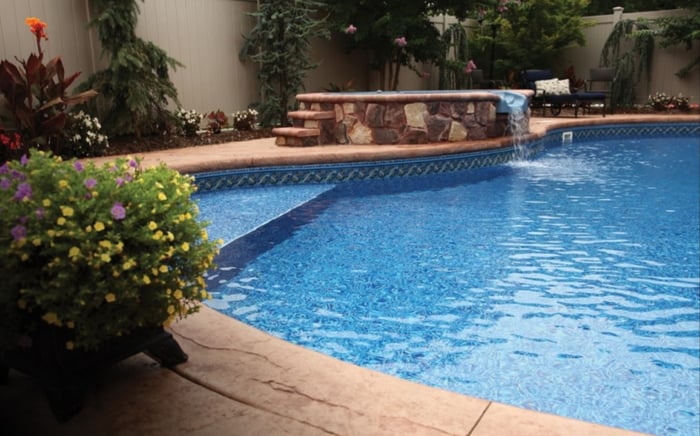
Before starting work building your pool, you will want to make sure you take care of a few preliminary steps to ensure your installation goes as smoothly as possible. This includes obtaining the proper permits, understanding local codes, having access to the needed utilities and choosing the right site for your pool.
BUILDING CODES / PERMITS
Advance knowledge concerning State and Local Swimming Pool Codes will prevent fines and work stoppage orders. Most ordinances vary considerably from one county to another and nothing should be assumed or implied. It may be necessary for the homeowner/pool builder to present dig specs and engineering specs to the local building department. You should also obtain a copy of the local swimming pool code for your area. Be sure that you understand all code requirements that are both directly and indirectly associated with your swimming pool. Take special note of sewer, drainage, fencing, lot line, power lines, fire, and electrical requirements.
IMPORTANT! Obtain the required permits before starting your swimming pool installation
UTILITIES REQUIRED
- Water- for construction and filling of pool
- Electrical- temporary supply during construction and a permanent supply for the pump and pool lighting
- Sewage- for adequate drainage
- Fuel for heater- Natural Gas or Propane
SELECTING THE POOL SITE
Obstructions
Obstructions must be considered before selecting the final pool site. Obstructions could include underground wires, gas lines, septic tanks, dry-well systems, plumbing, trees, and overhead power lines. Underground obstruction and utilities should be located before excavation begins. Utility companies will usually locate underground pipes and cables that are located on your property at no charge to you. If various obstructions are unavoidable, a compromise must be reached. However, keep in mind the labor and material costs of moving or replacing obstructions. We’ve found that most pool owners choose the path of least resistance for the sake of practicality and budget.
Sun and Shade
Sun and Shade can be an important factor when determining the pool site as well. Excessive shaded areas from trees and other buildings could result in uncomfortable swimming conditions during cooler weather months which could increase your heating costs considerably. Likewise, excessive sun can be unbearable for some during the summer months. You must determine your pools placement based on your personal preferences and ideal usage. Proper pool orientation will take advantage of sunny days for comfortable swimming condition, decrease heating costs, and in some states, meet requirements set forth by the public health department referring to diving board placement.
Existing Landscape Removal
Existing Landscape Removal is dependent on individual preference. A certain amount of removal might be possible without disturbing the natural atmosphere of the backyard. This can be done by careful use of planters, shrubs, and flowers. Of course, you will want to remove any trees/shrubs located directly inside the pool layout of your final chosen pool site. When it becomes necessary to remove trees, the entire root system needs to be excavated in order to avoid new trees sprouting through your pool and/or surrounding areas in the future. An effective method of preventing continued root growth is to apply copper sulfate to the root system.
Ease of Excavation
Ease of Excavation to provide the best access and most ideal working conditions. Placing the pool a few feet one way or the other, may permit improved excavation conditions, easier dirt removal and concrete placement.
Convenient Access to changing facilities and house exits also requires some thought. Available site lines for supervision of the swimming area from inside the house via windows and/or glass doors should also be considered. As you select your pool site, make a rough layout of where you think the pool should be located. Then consider decking and walk ways by staking out their approximate positions.
Location in Relation to Other Buildings
The Location of the Pool in Relation to Other Buildings should be both an aesthetic and practical consideration. Some considerations are whether the pool should be laid out parallel, perpendicular, or at a 45-degree angle to an existing house, building, building line, hedgerow, fence and/or another dominant object.
Subsoil Conditions
Advanced Knowledge of Subsoil Conditions can be helpful in determining the placement of the pool. It is advisable under certain circumstances (areas that have excavation issues) to probe the subgrade by boring a series of test holes. The results would suggest the best position and grade of the pool. Problems such as a rocky substrate, high water table, or excessive clay, should be located before construction. They can be eliminated simply by moving the pool, thus keeping the construction process as smooth and economical as possible.
Grade and Elevation
Check the Selected Location for Grade or Elevation of the Pool as the pool walls must rest on undisturbed soil. Keep the top surface of the pool (pool deck) at least three to four inches above the highest ground elevation in the area. This will avoid any surface drainage back into the pool.
Equipment Location
The Equipment Location should be included in your consideration as well:
- You’ll want to place your filter on a concrete slab. Be sure to make the slab large enough for all equipment, usually 3' X 4' or 3' X 7' with a heater. Also, consider at this time whether an enclosure will be built over the equipment in order to plan the slab size accordingly.
- Keep the filter within 20' of the pool to maintain optimum pump performance.
- Never locate the filter and pump more than six inches above or six inches below pool grade. Otherwise, pump priming or overflow problems are likely to occur.
- Never locate the filter and pump in a basement as it is possible that a malfunction in plumbing could cause flooding.
- Consider where the backwash water will drain. Is there adequate drainage? Check for local codes requiring special methods to dispose backwash water.
- The filter location is also important from an aesthetic point of view. When making the rough layout of the pool, visualize placement of the filter and plan for future landscaping or enclosures. Out of sight of the immediate pool area is usually preferred.